Introduction
In just two months, the Qianwen app skyrocketed from 3.06 million to 100 million monthly active users, driven by Alibaba’s strategic overhaul of its C-end AI products. This article deeply analyzes how this AI assistant has built barriers through ecosystem integration and task completion loops, revealing Alibaba’s true strengths and potential pitfalls in the AI battlefield.

After two weeks of effort, I have completed what I believe to be my most comprehensive analysis of an AI product to date.
Since the public beta launch of Qianwen in November 2025, I have closely monitored each update and trend, engaging in discussions with numerous AI industry professionals. I spent significant time organizing public information, comparing competitors, and dissecting product logic, culminating in this report.
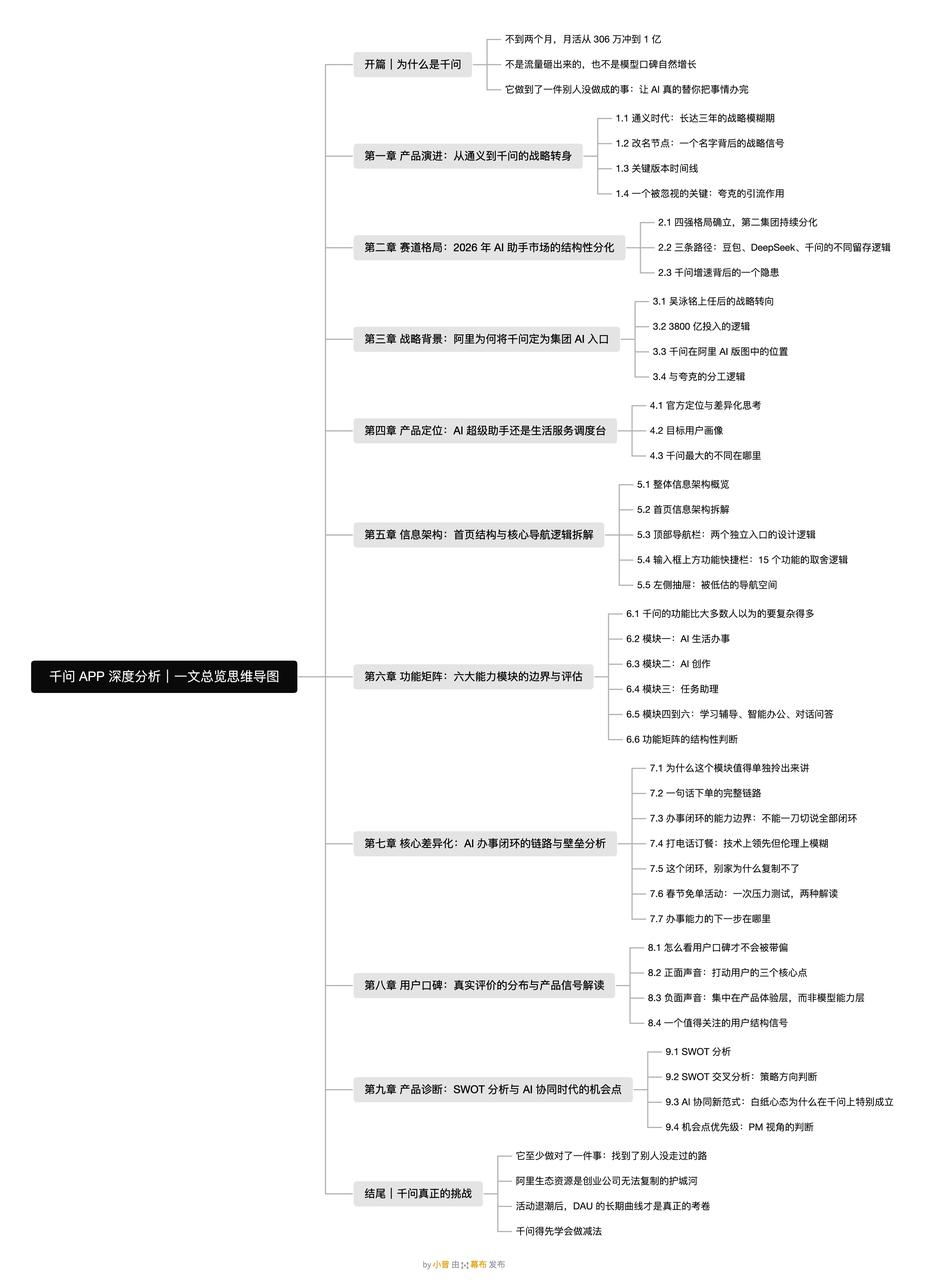
The content is expected to approach 20,000 words, analyzing Qianwen from multiple dimensions including product evolution, market landscape, strategic background, product positioning, information architecture, functional matrix, core differentiation, user feedback, SWOT analysis, and opportunity points.
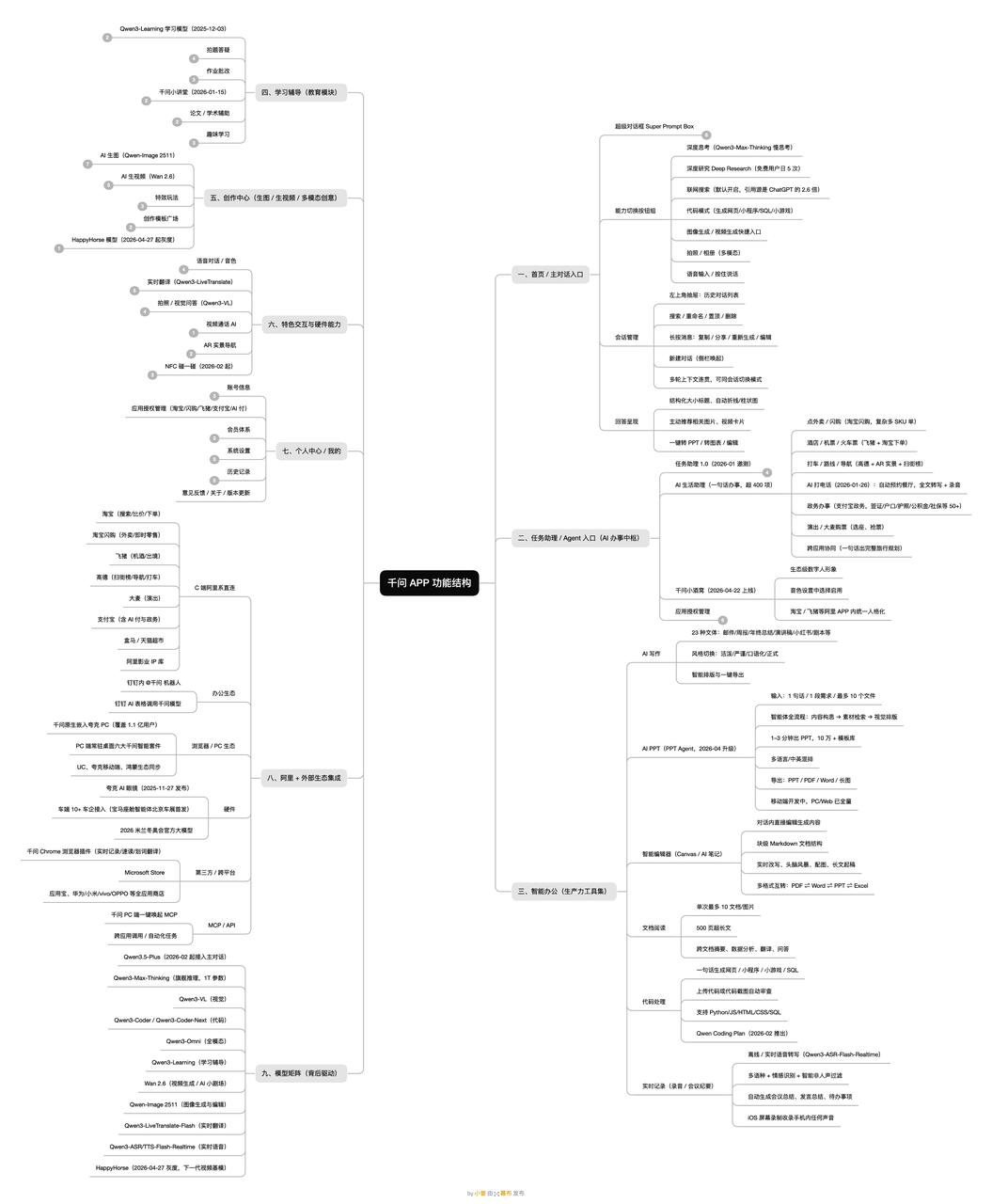
It is important to note that all opinions expressed here are personal and do not represent any institutional stance. If there are any misanalyses, I welcome discussions. Due to the length of the content, I have created a mind map overview for your reference:
Why Qianwen?
Qianwen achieved something unprecedented in the AI sector, with its monthly active users soaring from 3.06 million to 100 million in under two months. Crucially, it did not follow any existing paths: it did not rely on traffic from large companies or natural growth from model reputation. Instead, it accomplished what no other AI assistant has done—truly completing tasks for users.
This underlying product logic merits careful analysis.
I. Product Evolution: Strategic Shift from Tongyi to Qianwen
1.1 The Tongyi Era: A Three-Year Strategic Ambiguity
To understand Qianwen, one must first grasp why Tongyi failed. The Tongyi large model debuted in 2022, launching multiple products like Tongyi Qianwen and Tongyi Wanxiang. However, this led to significant confusion: users could not discern whether these were AI assistants, cloud computing services, or large models.
This cognitive dilemma is reflected in the data. By the third quarter of 2025, the Tongyi app had only 3.06 million monthly active users, while competitors like Doubao and DeepSeek had reached hundreds of millions.
Earlier in the first half of 2024, Tongyi’s active rate (DAU/MAU) was just 14.3%, with an average monthly usage of 4.3 days—both metrics significantly lagging behind competitors.
This is a typical predicament for technology-driven organizations venturing into consumer products: while the model’s capabilities are technically strong, the product logic has never been genuinely user-centric.
1.2 Renaming: A Strategic Signal Behind a Name
On November 14, 2025, Alibaba upgraded the Tongyi app from version 3.60.0 to 5.0.0, officially renaming it Qianwen. The jump from version 4 to 5 signals a restart rather than an iteration.
Alibaba’s official explanation for the renaming is that it represents a critical step in transitioning Tongyi from a technical model to a mass-market AI product. The core users of technical models are developers and enterprises, judged by model strength, while mass-market AI products target ordinary people, evaluated by their ability to solve real-life problems.
This renaming marks a clear shift: from a B-end technical showcase to a C-end life service entry point.
1.3 Key Version Timeline
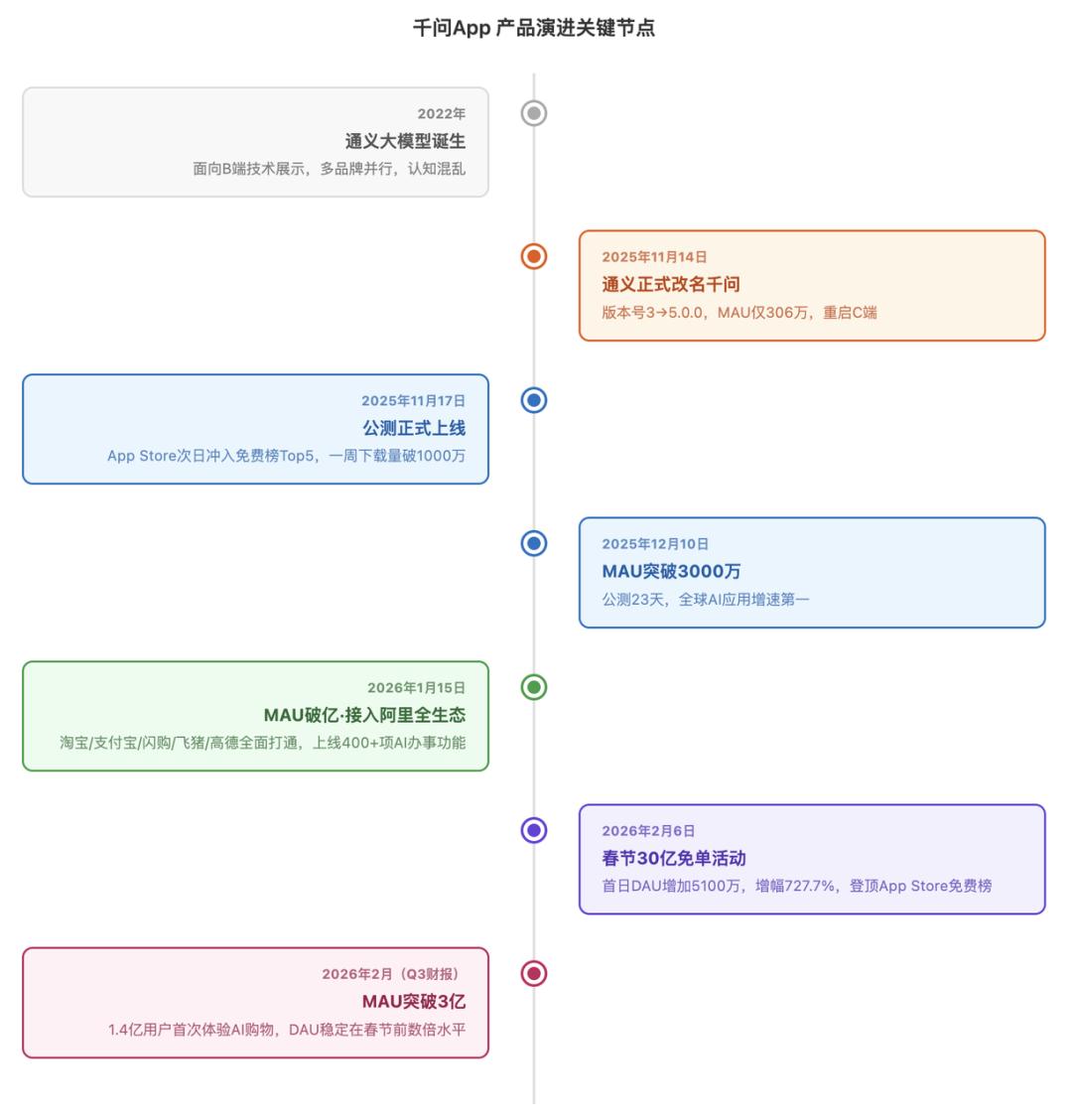
From renaming to reaching 100 million monthly active users, Qianwen followed a remarkably rapid evolution path: within 23 days of public testing, it surpassed 30 million monthly active users; by December 25, it exceeded 40 million; and on January 15, 2026, it broke the 100 million mark. On the same day, Qianwen held a product launch event, officially announcing full integration into the Alibaba ecosystem, marking the beginning of the AI task execution era.
A noteworthy detail in this timeline is that it took only two months to go from 3.06 million to 100 million MAU, while it took Alibaba three years to evolve from Tongyi to Qianwen.
These three years were not wasted; they completed two necessary preparatory tasks:
- Establishing the Qwen large model as the world’s leading open-source model, creating a significant advantage in model infrastructure.
- Standardizing various services within the Alibaba ecosystem into AI-callable interfaces.
Without these three years, Qianwen’s two-month explosion would not have been possible.
1.4 An Overlooked Key: The Traffic Role of Quark
Qianwen’s cold start was not from scratch. On November 26, 2025, Qianwen announced a deep integration with the Quark AI browser, which had an installation base of 110 million on desktop. This existing user base became the first wave of traffic for Qianwen.
Understanding this is crucial: part of Qianwen’s growth data reflects user migration rather than purely new user acquisition. The real test for Qianwen is how many of these migrated users will continue to engage frequently.
II. Market Landscape: Structural Differentiation in the 2026 AI Assistant Market
2.1 Establishing a Four-Strong Structure, Continuous Differentiation in the Second Group
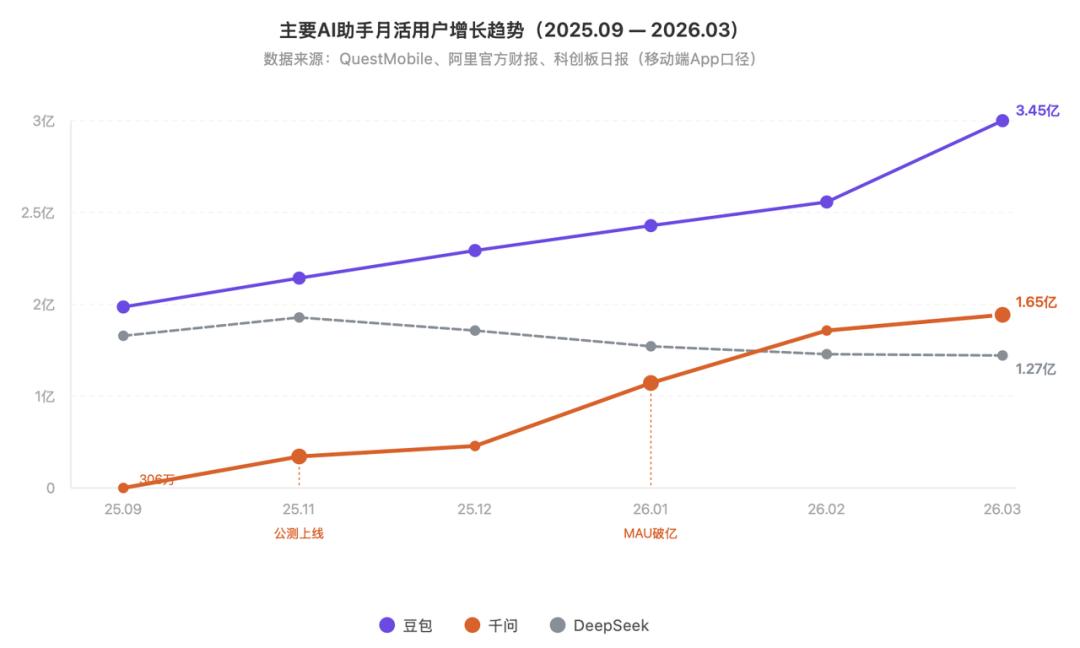
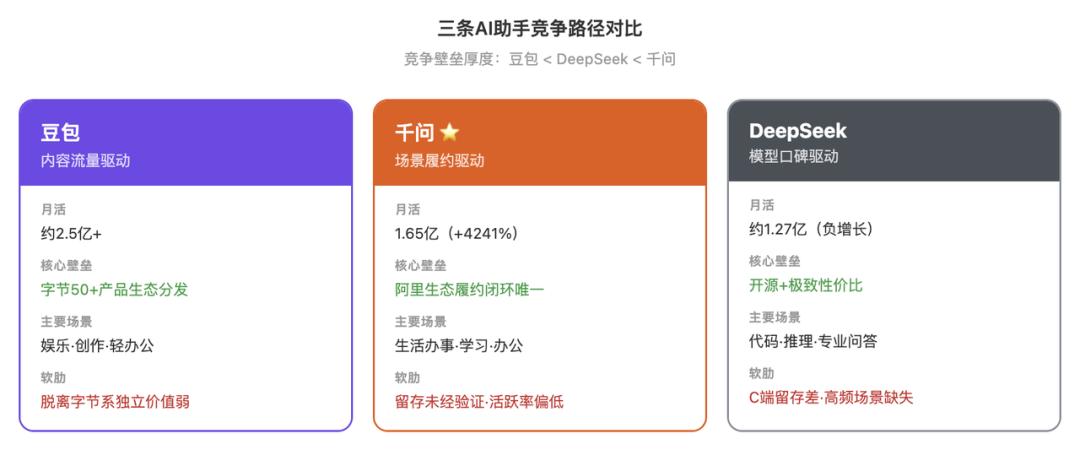
Looking at the data, according to QuestMobile’s March 2026 report, Qianwen’s mobile MAU reached 165 million, a year-on-year increase of 4241%, with a quarterly addition of 126 million—several times the new user growth of other AI products. Alibaba’s Q3 financial report for fiscal year 2026 disclosed that Qianwen’s total MAU across all platforms (App + Web + PC) exceeded 300 million in February.
A clarification on the metrics: 165 million refers to mobile app MAU, while 300 million refers to total MAU across all platforms. Both figures are accurate but should not be compared directly.
2.2 Three Paths, Essentially Three Different Retention Logics
After reviewing the data, it is more important to understand why these three companies have taken completely different paths.
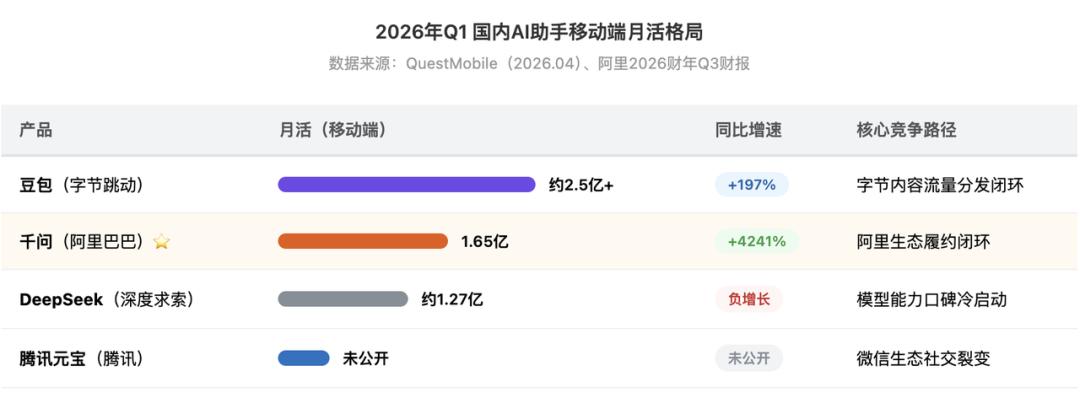
Doubao’s Path: ByteDance embedded Doubao into over 50 of its own applications, including Douyin, Toutiao, and Jianying, creating a closed loop of content consumption, AI assistance, and creative output. Users naturally encounter Doubao while browsing videos or editing, with retention based on content consumption habits. Its advantage is natural traffic and low customer acquisition costs; its disadvantage is that Doubao’s independent value diminishes outside the ByteDance ecosystem.
DeepSeek’s Path: DeepSeek gained high brand recognition among developers and professional users due to the phenomenal capabilities of its R1 model in early 2025. However, its weakness lies in insufficient consumer product strength, lacking specific high-frequency life scenarios to retain users, leading to negative monthly active growth.
Qianwen’s Path: Qianwen has established a closed loop where AI helps users complete tasks. It integrates with Taobao, Alipay, Taobao Flash Purchase, Fliggy, and Amap, launching over 400 AI task completion functions. This path is the most challenging but also has the highest barriers, requiring Alibaba’s decades of accumulated commercial infrastructure, which cannot be replicated merely by stacking model capabilities.
2.3 A Hidden Risk Behind Qianwen’s Growth Rate
While a 4241% growth rate looks impressive, one data point requires further analysis. On the first day of the Spring Festival free order event, Qianwen’s daily active users surged by 51 million, an increase of 727.7%. However, the peak driven by the event and real retention are two different matters. After the event ends, how many users will make Qianwen a daily habit will be the true test.
III. Strategic Background: Why Alibaba Positioned Qianwen as the Group’s AI Entry Point
3.1 Strategic Shift Under Wu Yongming’s Leadership
To understand Qianwen, one must first understand Wu Yongming. In September 2023, Wu Yongming became Alibaba’s CEO and established a user-first, AI-driven strategy in an all-staff letter on his third day. This was the first time Alibaba placed AI on par with e-commerce and cloud computing in importance.
However, the real strategic acceleration occurred in 2025. At the Cloud Summit in September 2025, Wu proposed an even more aggressive goal than AI-driven: AGI is a certainty, but AGI is just the starting point; Alibaba’s ultimate goal is ASI.
He outlined three stages: intelligent emergence, autonomous action, and self-iteration. The current stage is autonomous action, meaning AI must evolve from being able to answer questions to being able to execute tasks. Qianwen’s product logic is a direct product of this strategic phase.
3.2 The Logic Behind the 380 Billion Investment
Alibaba’s scale of investment in AI is a crucial background for understanding Qianwen’s strategic position. In February 2025, Alibaba announced a three-year plan to invest 380 billion yuan in AI infrastructure. This figure represents nearly 40% of Alibaba’s revenue for fiscal year 2025 and is a decision that requires the highest level of approval within the group. Subsequently, Alibaba’s Q1 financial report for fiscal year 2026 disclosed that over 100 billion yuan had been invested in AI infrastructure and R&D over the past four quarters.
This level of investment signifies that Alibaba does not allow a disconnect between strong AI infrastructure and weak C-end products. The emergence of Qianwen aims to genuinely connect model capabilities with C-end user scale.
3.3 Qianwen’s Position in Alibaba’s AI Landscape
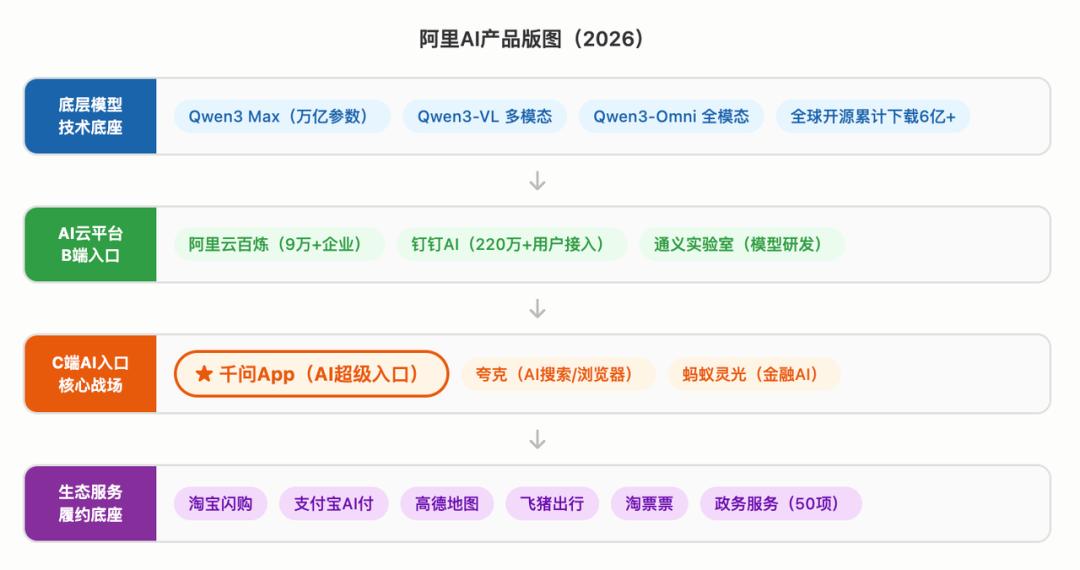
Qianwen’s positioning within this landscape is clear: it is not just a product; it is a scheduling layer. Model capabilities lie at the bottom, ecosystem services at the end, and Qianwen stands in the middle, responsible for converting users’ natural language intentions into specific service calls. Internally, Alibaba describes this positioning as having a Qianwen app that can solve all problems when you step out.
3.4 The Division of Labor with Quark
Many people are confused about the relationship between Qianwen and Quark, as there is significant functional overlap.
To break it down, the division of labor is as follows: Quark returns to its core capabilities (AI search and browser), serving the need for information retrieval; Qianwen addresses the need to complete tasks. The former focuses on information acquisition, while the latter focuses on task execution.
This division raises a question: as Qianwen’s AI search capabilities continue to enhance, the boundaries between the two will increasingly blur, creating internal competitive pressure that Alibaba needs to manage in the future.
IV. Product Positioning: AI Super Assistant or Life Service Scheduler?
4.1 Official Positioning and Differentiation Thinking
Qianwen officially positions itself as a personal AI assistant, with the slogan “can chat, can do tasks.”
Alibaba needs to quickly demonstrate its ability to call ecosystem services, resulting in a high density of functions; however, this high density also increases the cognitive cost for new users.
From a product manager’s perspective, the phrase “can chat, can do tasks” highlights that task execution is the true differentiation.
4.2 Target User Profile
Based on public data and product function design, Qianwen’s current user base can be roughly divided into three categories:
-
Student Group: The announcement of Qianwen surpassing 100 million MAU explicitly mentioned rapid growth among students and white-collar workers. The learning assistance module (Qianwen Classroom, full-page correction, 500 million resource database) is core to this group and is the most distinct differentiation. These users tend to have high usage frequency, fixed scenarios, but relatively low willingness to pay.
-
White-Collar/Professional Group: The intelligent office module (AI writing, AI PPT, document analysis, real-time recording) targets this group. This demographic has a higher willingness to pay, but competition is fierce, with Doubao and Kimi also in the same arena.
-
Life Consumption Users: This group was primarily attracted by the AI task completion functions during the Spring Festival free order event. Retaining these users is challenging, as they came in for promotions, and whether they continue to engage post-event depends on Qianwen’s daily usage value.
4.3 What Makes Qianwen Different
Compared to other AI assistants, Qianwen’s fundamental difference is that it is the only one that truly connects the commercial service execution loop.
Other AI assistants tell you where you can buy something; Qianwen directly helps you complete the purchase. This leap may seem minor, but it requires a complete set of commercial infrastructure support. This is its core barrier and the reason it deserves serious attention in 2026.
V. Information Architecture: Homepage Structure and Core Navigation Logic
5.1 Overview of Overall Information Architecture
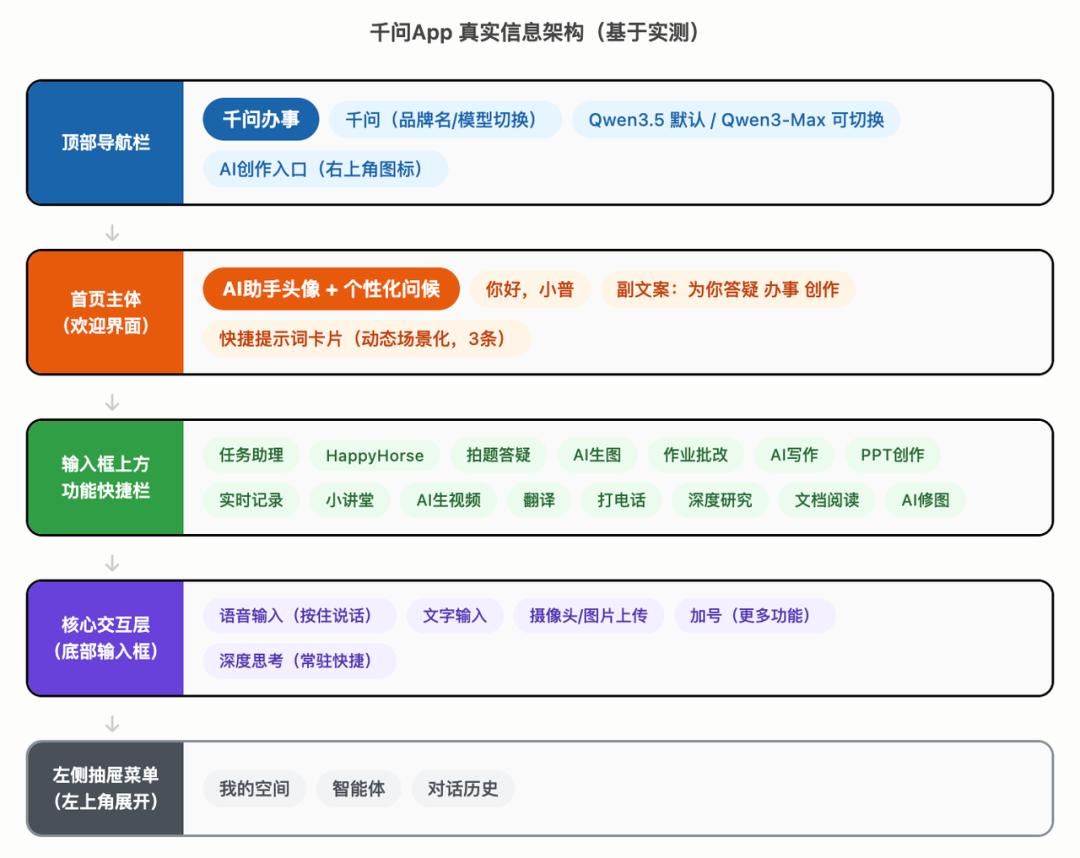
Upon opening the app, users are greeted with a minimalist dialogue welcome interface: an AI assistant avatar, personalized greeting “Hello, Xiao Pu,” and three scene-based quick prompts—nothing more.

This design choice is worth analyzing. Qianwen does not display all functions on the homepage but instead uses a “dialogue box” as the sole core entry point. This conveys a clear product proposition: no matter what you want to do, just say a word.
5.2 Breakdown of Homepage Information Architecture
The design logic of Qianwen’s homepage can be summarized as: large dialogue box + functional quick entry matrix.
At the top is a full-width dialogue input box, which serves as Qianwen’s core interaction entry. Whether you want to order takeout, write an article, or ask a question, it theoretically starts here. This design is correct, as it tells users: the core of Qianwen is to say a word, and the task begins.
5.3 Top Navigation Bar: Design Logic of Two Independent Entry Points
The top navigation bar contains two noteworthy design decisions.
Left Side Qianwen Task Completion Independent Entry
Qianwen does not mix its AI task capabilities within the homepage function bar but elevates it to the top left corner of the navigation bar. This is a clear product statement: task capabilities are an independent path separate from dialogue capabilities, allowing users to access them directly without going through the dialogue box.
This design logic is correct; asking a question and wanting to complete a task represent two completely different user intentions, and separating the entry reduces cognitive confusion.
Center Model Switch
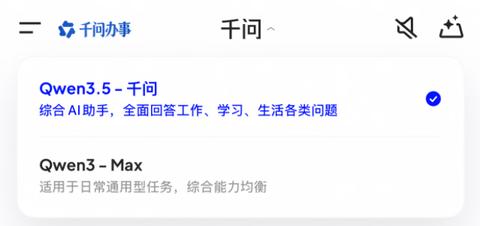
The center of the top bar features a model switch entry, defaulting to Qwen3.5, with the option to manually switch to Qwen3-Max.
For ordinary users, the differences between model versions are difficult to discern, so Qianwen chooses to display the latest model by default. Additionally, it does not showcase the model version on the homepage but retains only “Qianwen.”
Right Upper Corner AI Creation Entry
The icon in the upper right corner leads to the AI creation module, an independent content creation space distinct from the main dialogue interface.
5.4 Function Quick Bar Above the Input Box: Logic of Selection Among 15 Functions
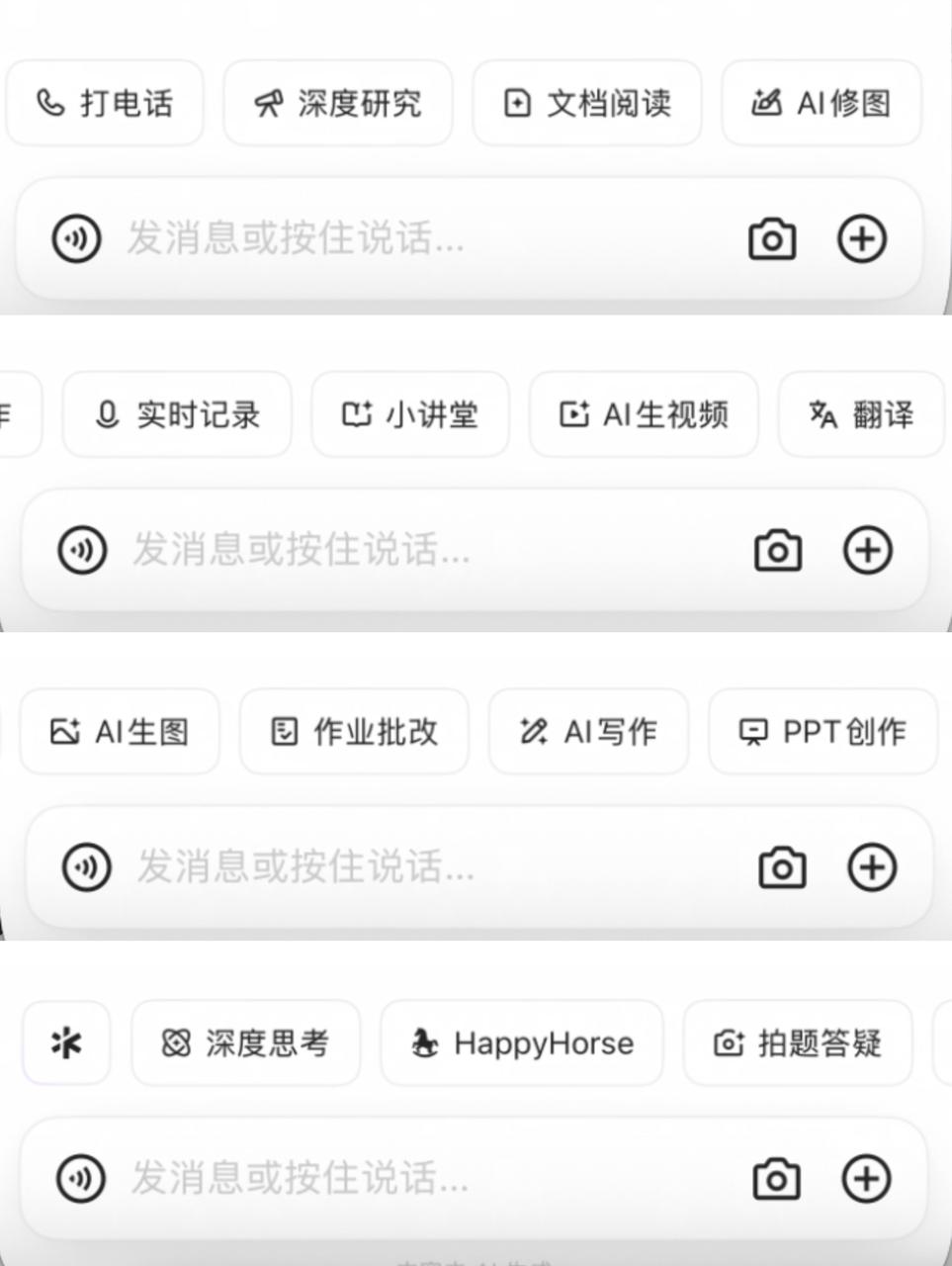
Above the input box, there are 15 function quick entry points arranged horizontally, in the order shown in the screenshot: task assistant, HappyHorse, question answering, AI-generated images, homework correction, AI writing, PPT creation, real-time recording, classroom, AI-generated videos, translation, phone calls, deep research, document reading, and AI photo editing.
Several noteworthy design insights include:
-
High functional density but not prominent. These 15 entries are arranged in a horizontally scrolling format above the input box, rather than occupying a large area with functional cards. Visually, this prevents the homepage from appearing cluttered, but for new users, whether they can discover this area and understand each icon’s meaning poses a challenge.
-
The prioritization of the first three functions is interesting: task assistant, HappyHorse, question answering. The task assistant represents “task completion,” HappyHorse is an emotional companionship feature, and question answering represents “learning.” This prioritization reveals Qianwen’s judgment about its core user groups: task users, emotional users, and student users—these are the three groups it most wants to serve first.
-
The phone call function being highlighted is noteworthy. This is a unique capability of Qianwen: AI replaces users in making calls to complete appointments and inquiries. This function appears in the function bar but is ranked 12th in priority. If this function matures, it should have a higher display weight, as its differentiation far exceeds standard features like AI writing and translation.
5.5 Left Drawer: An Underestimated Navigation Space
In the top left corner, expanding reveals my space, intelligent agents, and dialogue history.
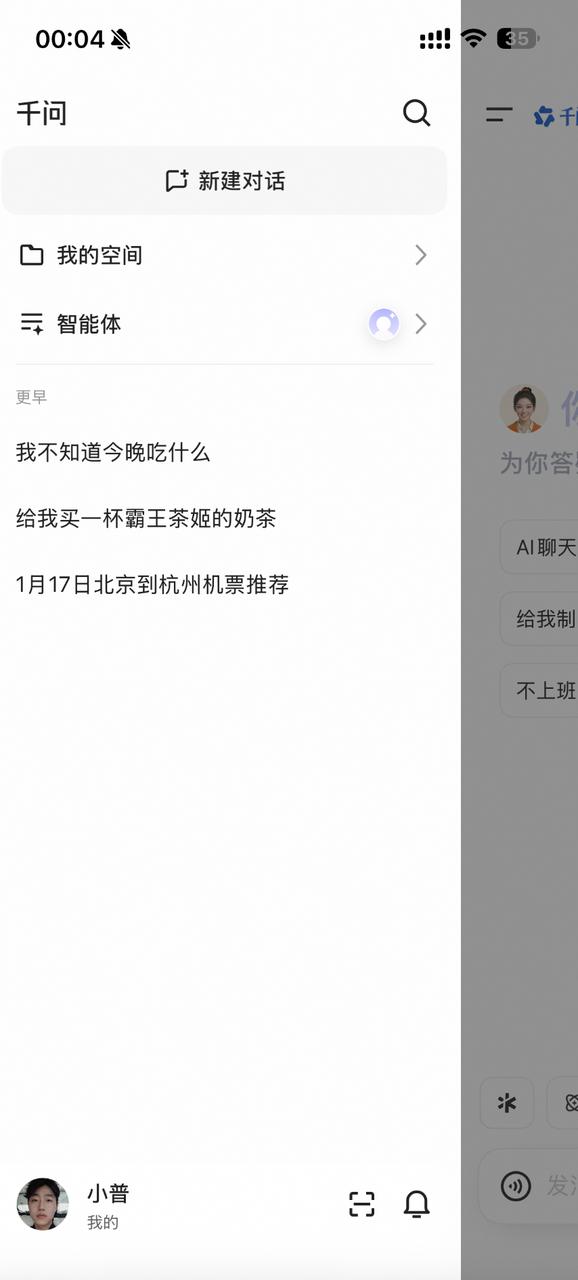
The presence of intelligent agents here is a noteworthy signal. Qianwen places the intelligent agent entry in the drawer rather than the main homepage navigation, indicating that the current version views intelligent agents as advanced user features rather than core scenarios for the general public. This contrasts with Doubao’s strategy of making the Bot square a main navigation tab.
Which strategy is better depends on Qianwen’s assessment of intelligent agents: it believes ordinary users are not yet ready for high-frequency use of intelligent agents, with the dialogue box being the lowest threshold entry at this stage. This judgment may not be wrong, but as user familiarity increases, the entry level for intelligent agents should be adjusted accordingly.
VI. Functional Matrix: Boundaries and Evaluation of Six Major Capability Modules
6.1 Clarifying One Thing: Qianwen’s Functions Are More Complex Than Most People Realize
Before formally dissecting, I want to correct a previous misjudgment of mine.
Before truly delving into this product, I perceived Qianwen as merely a task-capable AI assistant with a pile of functions. However, when you lay out its functional matrix, you realize it actually follows two completely different product lines:
One is the AI task completion super entry, targeting your lifestyle; the other is the AI creation platform, targeting your content needs.
These two lines share a dialogue box entry but have nearly independent capability systems and target users. This is both Qianwen’s product ambition and its most challenging positioning ambiguity.
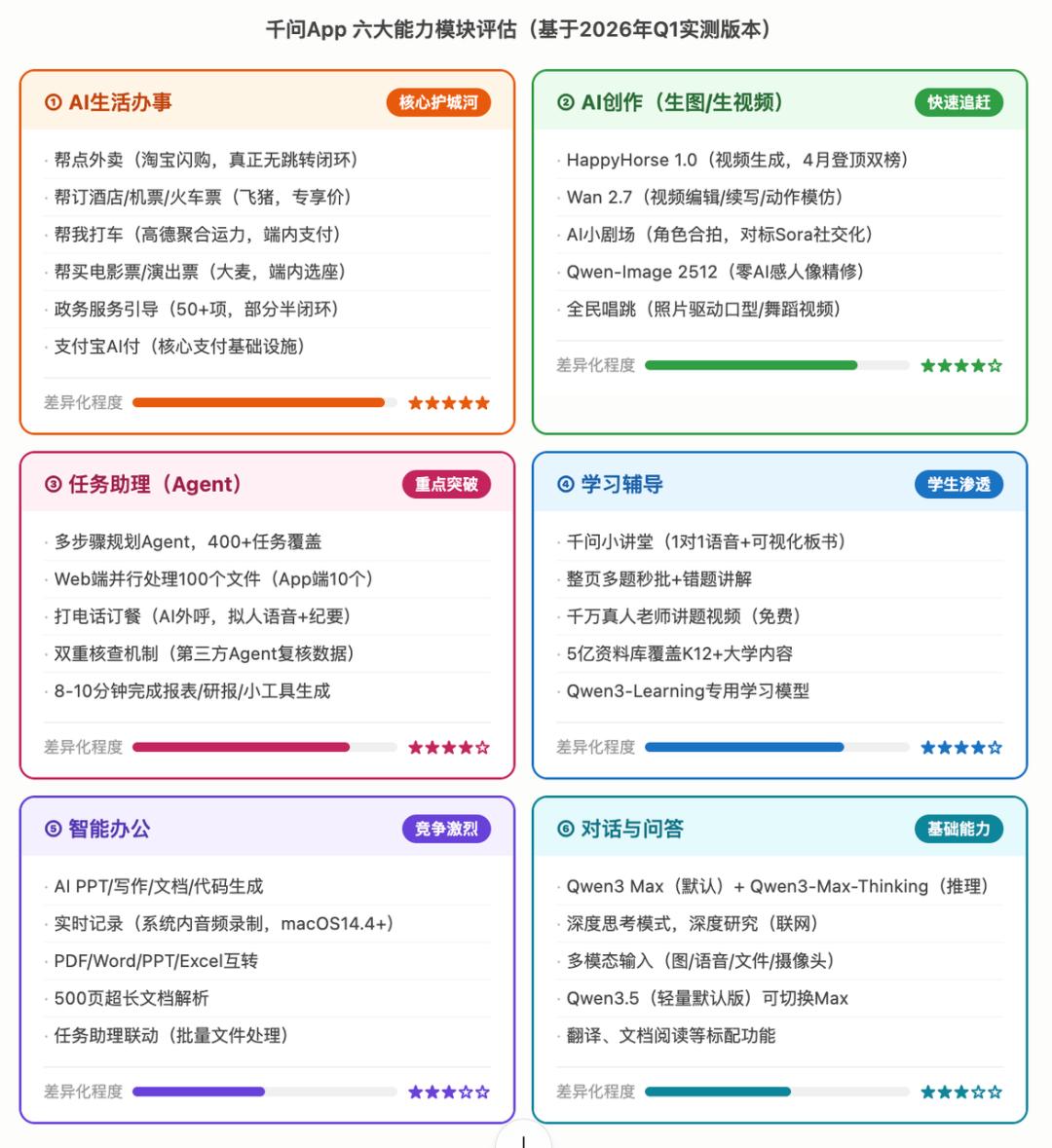
Breaking down the functional matrix into six modules:
6.2 Module One: AI Life Task Completion
This is the only module among the six where one can confidently say, “This is something only it can do.”
However, it must be clarified that the so-called 400+ AI task completion functions do not mean all 400 are fully realized as seamless closed loops. Based on actual integration levels, they can be divided into three tiers:

This distinction is crucial. Equating all 400+ with true closed loops exaggerates Qianwen’s actual capabilities and may create expectation gaps for readers.
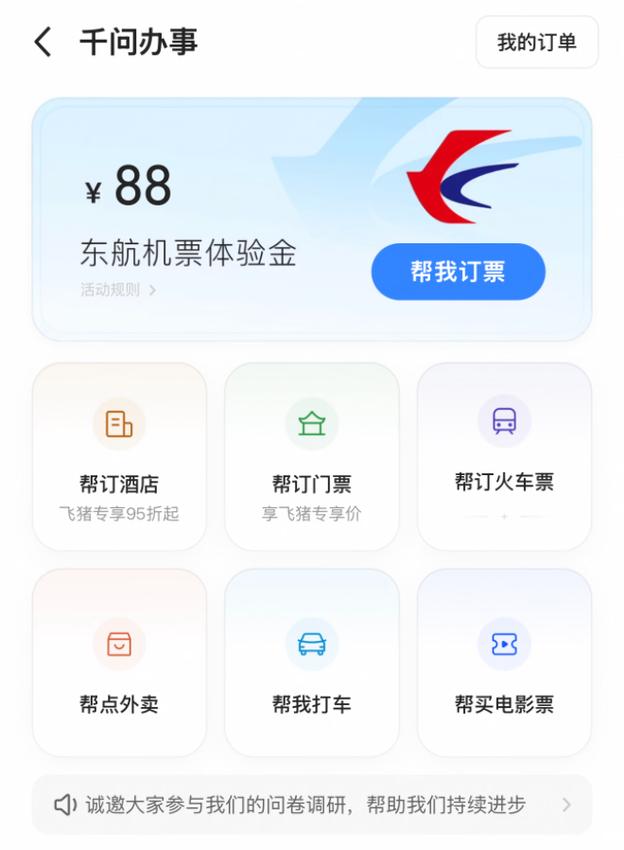
The phone call ordering function deserves special mention. Qianwen automatically dials the merchant’s phone, using AI voice (real-time emotion recognition, recognizing over 50 emotions within 100 milliseconds) to complete reservation communication, then generates a text summary and playback of the recording.
This task is technically complex and addresses a real pain point: many people dislike making calls, especially for complex tasks like communicating with restaurants in Chinese. However, it also raises an unexpected issue: merchants often think they are speaking with a real person, leading Qianwen to have to declare at the end of the call: “I am Qianwen AI assistant.” This detail reveals an unresolved issue: the ethical and commercial rules surrounding AI impersonating humans in interactions.
6.3 Module Two: AI Creation
If task completion is Qianwen’s rational barrier, then AI creation is its emotional barrier.
A common misconception must be corrected: HappyHorse is not an emotional companionship feature, but rather Alibaba’s self-developed video generation model.
HappyHorse 1.0’s technical specifications include: 15 billion parameters, 40-layer single-stream Transformer architecture, native audio-video joint generation, and support for lip-sync in seven languages, producing a video in 38 seconds on a single H100 card. In April 2026, it anonymously topped both the AI-generated video and image generation rankings, subsequently claimed by Alibaba’s ATH Innovation Division. It began gray testing on the Qianwen app homepage in the form of a “capsule entry” on April 27, allowing ordinary users to experience it for free.
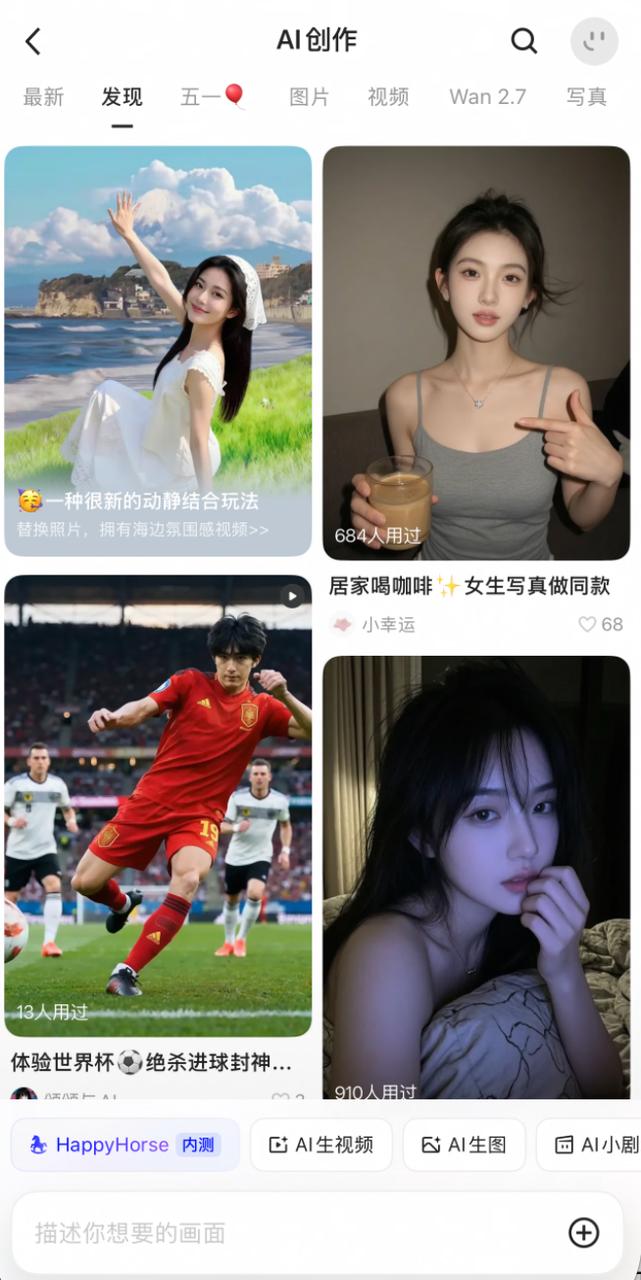
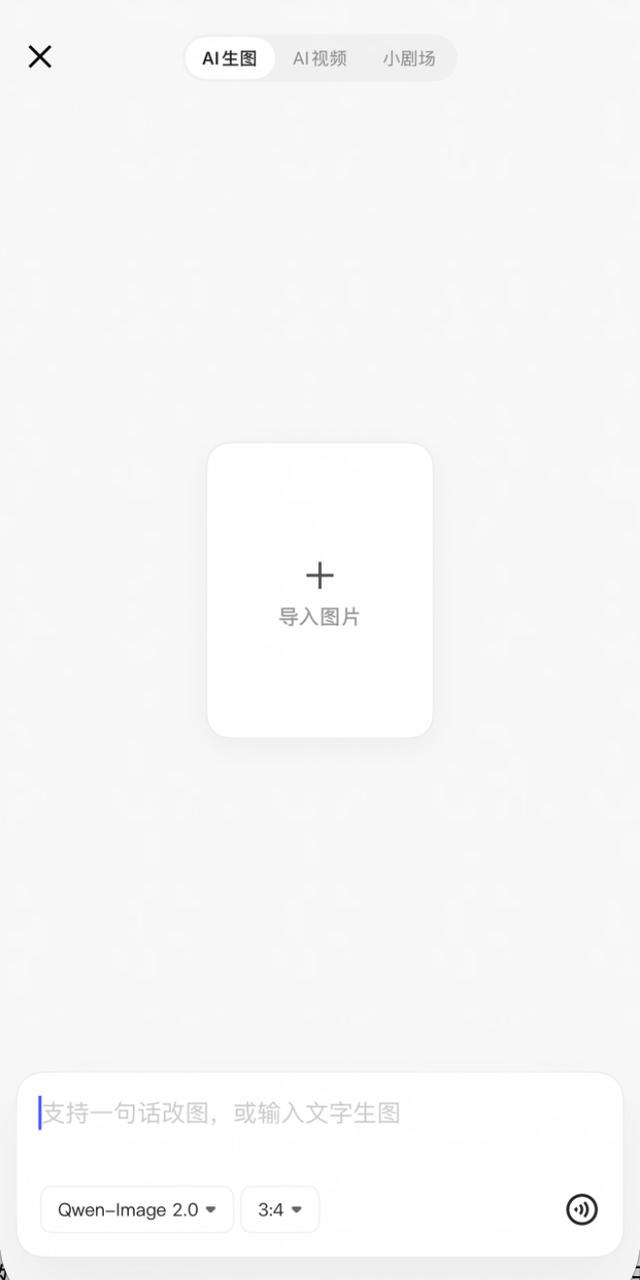
The AI Mini-Theater is another noteworthy feature. It is the first domestic AI product to create a role-playing interaction—users upload photos to create digital avatars and perform alongside nearly a hundred public IPs (like Zhen Huan, Lin Daiyu, Sun Wukong, Elon Musk, etc.) in AI shorts, with the results saved as Live images for social media.
This strategic intent is clear: to penetrate the entertainment and social scene, addressing the issue of low daily active users for Qianwen. Users will repeatedly open the app to see themselves in a video with Musk—this represents a retention path that does not rely on Alibaba’s e-commerce ecosystem.
6.4 Module Three: Task Assistant
Task Assistant 1.0 was launched in invite-only testing on January 15, 2026, with initial invitation codes reportedly selling for 500 yuan on Xianyu, indicating high user anticipation.
Its capability is positioned as a human-like multi-step planning agent: you describe a complex task, and it automatically breaks it down into steps, calls tools, executes, and outputs results. The web version can handle up to 100 files in parallel, while the app version can manage 10, completing a report or small tool in an average of 8 to 10 minutes. It also introduces a dual-check mechanism, allowing key data to be verified by a third-party agent to reduce hallucination risks.
This module and the phone call ordering function share the same underlying agent infrastructure, with one focused on information processing and the other on physical execution. Together, they define Qianwen’s true AI agent capability boundaries.
Currently, the task assistant is still in invite-only testing, with ordinary users not yet fully covered. Once it opens fully and continues to refine its functions, this module is likely to establish long-term user habits for Qianwen.
6.5 Modules Four to Six: Learning Assistance, Intelligent Office, Dialogue Q&A
Learning Assistance: This is the module where Qianwen penetrates the student group most deeply. The Qianwen Classroom turns AI tutoring into a visual board and 1-on-1 voice interaction format, while full-page question correction directly addresses core scenarios for parents and children. The 500 million resource database, combined with millions of real teachers’ video explanations, provides real differentiation. Compared to vertical products like Yuanfudao and Zuoyebang, Qianwen’s advantages are its free and universal nature; its disadvantages lie in the lack of a systematic course structure and in-depth content.


Intelligent Office: AI writing, PPT, document analysis, and real-time recording are standard features for AI assistants, with Qianwen following in this space, showing little differentiation. Notably, the real-time recording supports recording internal audio, allowing users to record Xiaoyuzhou, Bilibili, and podcasts, adding a use case that most competitors lack.
Dialogue and Q&A: The underlying technology is Qwen3 Max (default mode, non-inferential) and Qwen3-Max-Thinking (inferential mode), with the default version being Qwen3.5, which users can manually switch to Max. In terms of capability, it is on par with ChatGPT and Gemini, and completely free—this is a genuine advantage in the current context of AI products becoming commercialized. However, as mentioned in the information architecture section, the perception of model capability is insufficient, making it hard for users to feel that “this is Qwen3 Max helping me” during dialogues.
6.6 Structural Judgment of the Functional Matrix
When looking at the six modules together, a clear structure emerges:
Qianwen has two truly differentiated core capabilities—AI life task completion (its moat) and AI creation (especially HappyHorse + AI Mini-Theater, which serves as a growth flywheel). The task assistant is a third potential pillar but is still under development.
The other three modules (learning assistance, intelligent office, dialogue Q&A) have strength but lack uniqueness, facing competition from Doubao and Kimi without clear advantages.
This structure indicates that Qianwen needs to penetrate the first two areas effectively, rather than spreading resources thinly across all six directions in pursuit of perfection.
VII. Core Differentiation: Analysis of the AI Task Completion Loop and Barriers
7.1 Why This Module Deserves Separate Discussion
In the functional matrix, AI life task completion is the only module that has received a five-star differentiation rating.
This is not because other functions are poor, but because this module has achieved something: it is the world’s first product that truly connects the complete chain of search, decision-making, payment, and fulfillment in the AI assistant sector. This is not just a promotional claim; it is a product form reality.
Doubao can tell you what good food is nearby. Qianwen helps you place the order.
This leap may seem small, but the underlying requirements are entirely different.
7.2 The Complete Chain of One-Click Ordering
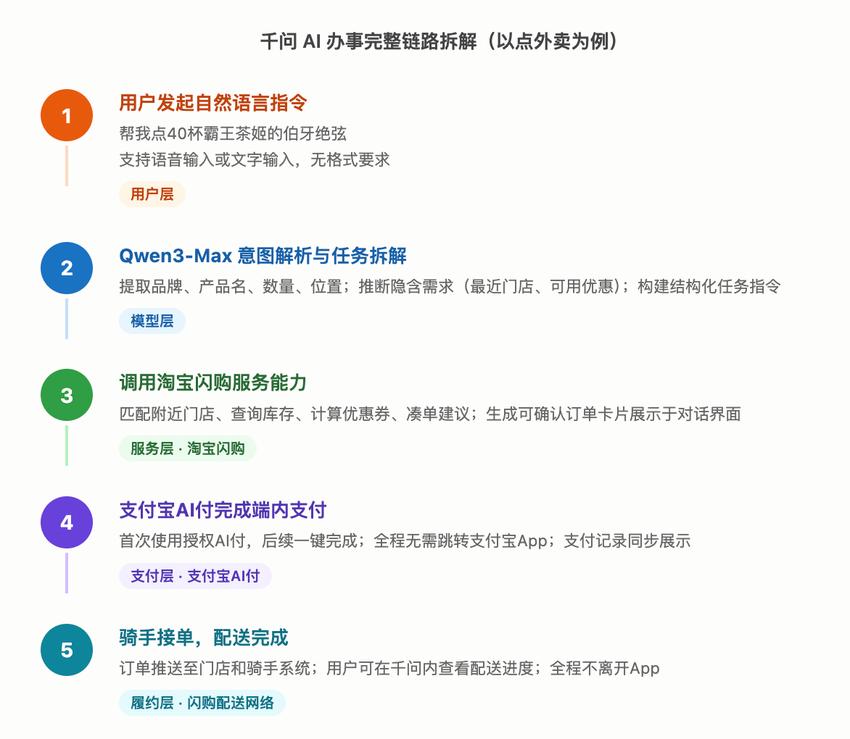
Let’s start with a typical scenario. At the launch event on January 15, 2026, Qianwen’s C-end business group president, Wu Jia, stated: “Help me order 40 cups of Bawang Tea Ji’s Boya Jue Xian.”
Qianwen subsequently completed the following tasks: identifying the product brand and name, locating nearby stores, checking inventory and available discounts, generating an order card, and using Alipay AI to complete the payment, with the rider delivering the order.
The entire process involved no switching or manual operations, and 8 minutes later, the tea arrived at the event.
To validate this chain, I prepared to buy some snacks and a tool for ear cleaning.
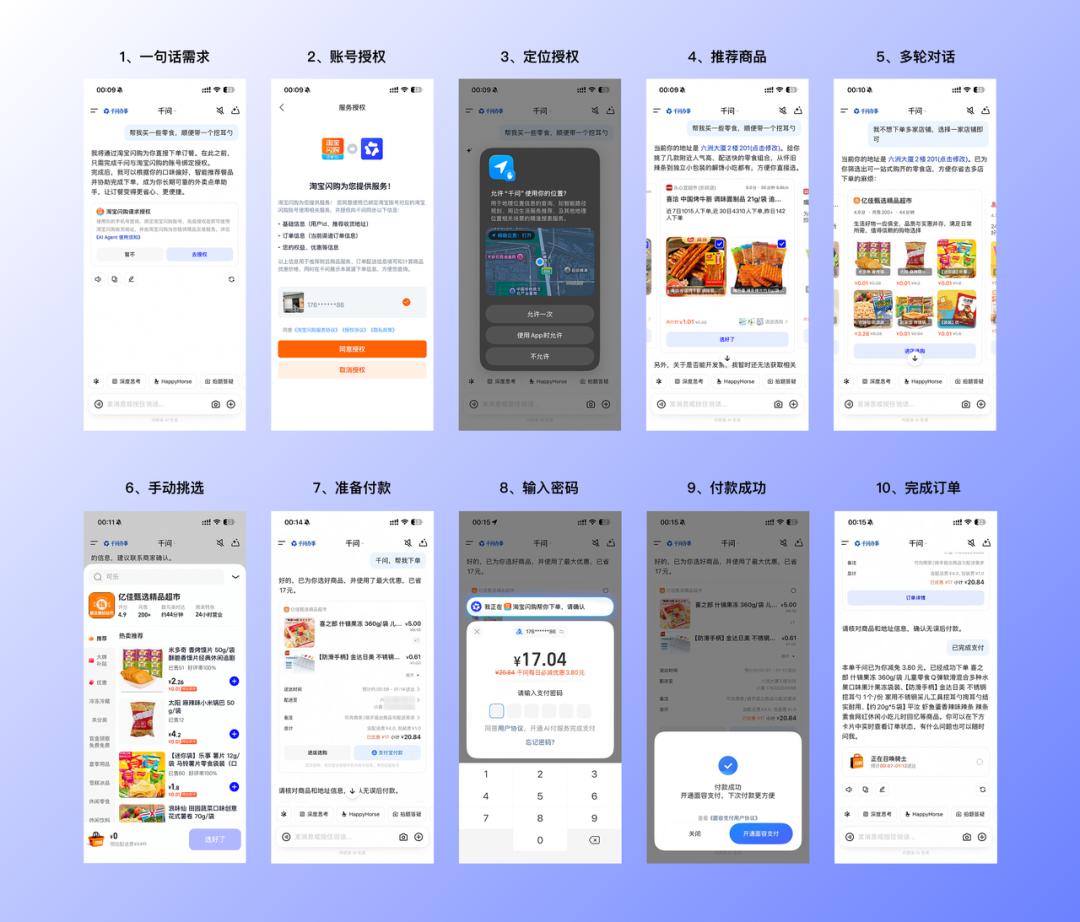
Breaking down this chain reveals three technical nodes:
-
Intent Understanding: Qwen3-Max needs to parse the brand, product name, quantity, and location information from a natural language sentence while inferring implicit needs, such as prioritizing nearby stores and automatically matching available discounts. This relies on the large model’s multimodal understanding capabilities.
-
Service Invocation: After parsing the intent, Qianwen must call the Taobao Flash Purchase product library, store library, and discount system in real-time to complete merchant matching and order generation. This depends on Taobao Flash Purchase’s years of accumulated local life database and API interface system.
-
Payment Closure: In traditional processes, after the AI recommends products, users must switch to a payment app to complete the payment. Qianwen, through the jointly developed AI payment capability with Alipay, embeds payment authorization into the dialogue process, eliminating the need for repeated operations after the initial authorization.
7.3 Capability Boundaries of the Task Completion Loop: Not All Loops Are Seamless
A crucial point to clarify is that the 400+ AI task completion functions officially promoted by Qianwen do not mean that all 400 items achieve seamless in-app closed loops. Based on actual integration levels, they can be divided into three tiers:
- Fully Closed Loop: This includes takeout, ride-hailing, movie tickets, and event tickets. Users complete the entire process from ordering to payment within the Qianwen interface without needing to switch out. This is the core differentiating capability.
- Basic Closed Loop: This includes hotels, flights, and train tickets. Payment steps are completed within the app, but some confirmation processes may redirect to the Fliggy page. The experience has some breaks but remains relatively smooth.
- Guiding Type: This includes government services, mobile top-ups, etc. These primarily use entry cards and guiding links rather than true automated execution loops.
This tiered distinction is important. When evaluating Qianwen’s task capabilities, it is essential to differentiate among these three categories rather than conflating all services.
7.4 Phone Ordering: A Technically Advanced Yet Ethically Ambiguous Function
The phone ordering capability deserves a separate discussion.
Qianwen automatically dials the merchant’s phone, using AI voice to complete reservation communication. The underlying technology involves real-time emotion and intent recognition engines, identifying over 50 emotions within 100 milliseconds, achieving a high level of anthropomorphism. After completion, it generates a text summary and recording playback, with the entire process requiring no verbal input from the user.
This addresses a genuine pain point: many people dislike making calls, especially in noisy environments or when uncertain about the other party’s attitude. AI handling phone calls represents a significant efficiency boost.
However, it also introduces an unexpected issue: merchants often believe they are conversing with a real person, leading Qianwen’s team to declare at the end of the call that they are the AI assistant. This detail exposes an unresolved issue: where are the ethical and commercial boundaries for AI impersonating humans in interactions? This is not just a problem for Qianwen but a question that the industry must confront as the first product to implement this capability.
7.5 Why Others Cannot Replicate This Loop
This is the most critical question in the entire analysis: why can’t Doubao, DeepSeek, or Yuanbao achieve the same thing?
Doubao is also pursuing a similar direction. It follows a system-level permission route, replacing user operations in WeChat, Taobao, Meituan, and other third-party apps. This route is more aggressive technically but has faced serious resistance: within 72 hours of launch, some users had their WeChat accounts flagged for unusual logins, Taobao’s price comparison triggered platform risk controls, and multiple banking apps initiated restrictions.
Qianwen’s approach is entirely different. It does not manipulate others’ apps but allows all services to actively connect to Qianwen’s scheduling interface. The fundamental difference between these two routes lies in:
- Qianwen’s Approach: Building a comprehensive ecosystem where services willingly integrate, creating a seamless user experience.
- Doubao’s Approach: Attempting to control external applications, which leads to friction and regulatory challenges.
This distinction is key to understanding why Qianwen can achieve what others cannot.
Comments
Discussion is powered by Giscus (GitHub Discussions). Add
repo,repoID,category, andcategoryIDunder[params.comments.giscus]inhugo.tomlusing the values from the Giscus setup tool.